Friday, January 9, 2015

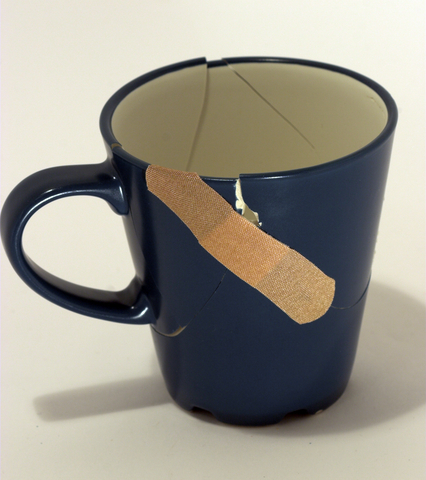
Broken Cup


Excerpt from Tantra Vision : The Door to Nirvana by Osho
"Just the other night a sannyasin who is going back was saying that love between her and her husband has disappeared. Now they are hanging together just for the children.
I told her to meditate, to be friendly to the husband. If love has disappeared, all has not disappeared; friendship is still possible. Be friendly. And she said 'It is difficult. When a cup is broken, it is broken.'
I told her that it seemed she had not heard that Zen people in Japan will first purchase a cup from the supermarket, bring it home, break it, then glue it together again to make it individual and special. Otherwise it is just a market thing.
And if a friend comes and you give him tea in an ordinary cup and saucer, that is not good; that is ugly, that is not respectful. So they will bring a fresh new cup, and break it.
Of course, then there is no other cup in the world exactly like it --there cannot be. Glued together, now it has some individuality, a signature.
And when Zen people go to each other's house or each other's monastery, they will not just sip the tea. First they will appreciate the cup, they will look at it. The way it has been joined together is a piece of art -- the way the pieces have been broken and put together again.
The woman understood, she started laughing. She said 'Then it is possible....'!"

For any relationship, it's not about how its broken, it's how we fix it that makes us all unique :)

Friday, May 30, 2014

Zip your lip


One day, a student came up to the great philosopher.  “Socrates, I have just heard some news about one of your friends.”  he excitedly exclaimed.

“Before you tell me this news, we need to make sure that it passes the triple filter test,” responded Socrates.

“What’s the triple filter test?” the man asked.

“The first test is that of truth.  Tell me, do you know that what you’re going to tell me is absolutely true?”  asked Socrates.

After thinking for a moment, the man said, “I heard this news from someone else, so I’m not 100% sure if it’s true.”

“The second test is that of goodness,” Socrates continued, “Is what you’re about to tell me something good?”

“No, actually it’s the opposite…”

Socrates interrupted the man, “So what you’re going to tell me is neither true, nor good?”

The man was slightly embarrassed and shrugged his shoulders.

Socrates continued, “There is one final test which is usefulness.  Is what you’re about to tell me going to be useful?”

“Probably not,” the man replied.

“Well, if you’re going to tell me something that’s not true, good or useful, then why tell me at all?” responded the philosopher.

We've all indulged in a bit of gossip from time-to-time.  We all come across salacious information about someone occasionally that we feel compelled to pass on to others. Next time  pass the information through the triple filter test & if it fails, zip your lip :)

“Without wood a fire goes out, without gossip a quarrel dies down.” - Proverbs 26:20

Source - Internet

Friday, February 14, 2014

Love is a VERB


Mostly we think of love as a feeling probably because of its depiction in books & movies; love is an emotion that washes over us when we meet that right person. At first we’re swept up with everything they do and can’t wait to see them again. All emotions are cranked up to the max and the intense brightness lights up everything. We’re happy. We’re in love.
As time slowly passes the feeling starts to fade — it’s still very bright but the madness of it all has tapered and leveled out. You aren’t always consumed by what your love is doing or thinking. You’re off that initial high.
As more time passes real world problems begin to surface. What drew you to that person is now beginning to get on your nerves: disagreements, or annoying habits. The rose colored glasses are off and what you see before you is a real person, the fantasy you initially fell in love with is fading away and replaced with a real person.
Love isn’t just a feeling that washes over you and lasts a lifetime. It is a gift that requires attention, work and dedication. What you put into that love is what you will receive back. Why not change how you think of love today? Make the change — love is more than just a word — love is a verb.

I think that I can't add anything more, as Covey made it clear, that we always oversee the "verb" side of things, and we just see the noun, the result of the verbs, as if we expecting the result without trying the verb to get it.
You probably don't always feel loving feelings for your mother or father or siblings or best friend, but you know you love them. The feeling of love is a fruit of love, the verb. It is by our actions that we love and not by our words. Very interesting observation as it implies that we do not act because of our feelings towards a person, but rather our actions induce our feelings. 
Excerpt about love from Steven Covey's book "The Seven Habits of Higly Effective People".

At one seminar where I was speaking on the concept of proactivity, a man came up and said, “Stephan, I like what you’re saying. But every situation is so different. Look at my marriage. I’m really worried. My wife and I just don’t have the same feelings for each other we used to have. I guess I just don’t love her anymore and she doesn't love me. What can I do?”
“The feeling isn’t there anymore?”, I asked.
“That’s right,”, he reaffirmed, “And we have three children we’re really concerned about. What do you suggest?”
“Love her,” I replied.
“I told you, the feeling isn’t there anymore.”
“Love her”
“You don’t understand. The feeling of love just isn’t there”
“Then love her. If the feeling isn’t there, that’s a good reason to love her.”
“But how do you love when you don’t love?”
“My friend, love is a verb.  Love- the feeling – is a fruit of love, the verb. So love here. Serve her. Sacrifice. Listen to her. Empathize. Appreciate. Affirm her. Are you willing to do that?”

In the great literature of all progressive societies, love is a verb. Reactive people make it a feeling. They’re driven by feeling. Hollywood has generally scripted us to believe that we are not responsible, that we are a product of our feelings. But the Hollywood script does not describe the reality. If our feelings control over actions, it is because we have abdicated our responsibilities and empowered them to do so.

Proactive people make love a verb. Love is something you do: the sacrifices you make, the give of self, like a mother bringing a newborn into the world. If you want to study love, study those who sacrifices for others, even for people who offend or do not love in return. If you are a parent, look at the love you have for the children you sacrificed for. Love is a value that is actualized through loving actions. Proactive people subordinate feelings to values. Love, the feeling, can be recaptured.

Source - Internet

Friday, November 8, 2013

Our words create our worlds

A man joined a monastery in which the monks were allowed to speak only two words every seven years. After the first seven years had passed, the new initiate met with the abbot, who asked him, "Well, what are your two words?"

"Food's bad," replied the man, who then went back to his silence.

Seven years later the clergyman asked, "What are your two words now?"

"Bed's hard," the man responded.

Seven years later - twenty-one years after his initial entry into the monastery - the man met with the abbot for the third and final time. "And what are your two words this time?" the abbot asked.

"I quit."

"Well, I'm not surprised," the cleric answered disgustedly. "All you've done since you got here is complain!"

Don't be like that man; don't be known as a person whose only words are negative. If you're a member of the "negative grapevine," resign.

Contrary to what you may have heard, talk is not cheap. Talk is powerful! What we say is important. Our vocabulary should be filled with words of hope and dreams. Be known as someone who speaks positively.

Source: Internet

Friday, March 1, 2013

Always Right

When the populace of a certain village were evenly divided on the ‘right’ way to punish a disobedient child, they decided to seek council with the village elder. The spokesman for Opinion A gave his view to the elder. As the others listened in silence, the elder spoke, “You are right.”

While maintaining his decorum, but visibly upset, the spokesman for Opinion B said, “But Wise One, you have given your counsel before hearing from me!” He then shared his opinion with the elder. After listening to it, the Wise One said, “You are right.”

“But, Honorable One,” protested another villager, “you have just agreed with two opposing viewpoints!”

The Wise One turned his way and said, “You are right.”

We can never be right until we realize everyone is right. The truth is owned by none and shared by all. Whether you agree with this or not, “You are right.”

Source - http://www.personal-development.com/chuck/beingright.htm

Friday, January 25, 2013

Infinite Power of One - 1∞

A man was walking along a deserted beach at sunset. As he walked he could see a young boy in the distance, as he drew nearer he noticed that the boy kept bending down, picking something up and throwing it into the water. Time and again he kept hurling things into the ocean.

As the man approached even closer, he was able to see that the boy was picking up starfish that had been washed up on the beach and, one at a time he was throwing them back into the water.

The man asked the boy what he was doing, the boy replied,"I am throwing these washed up starfish back into the ocean, or else they will die through lack of oxygen. "But", said the man, "You can't possibly save them all, there are thousands on this beach, and this must be happening on hundreds of beaches along the coast. You can't possibly make a difference."

The boy looked down, frowning for a moment; then bent down to pick up another starfish, smiling as he threw it back into the sea. He replied, "I made a huge difference to that one!"

There are many issues around us that need to be set right. We understand that we cannot make a huge difference to all of them. But we can do our bit and maybe if we all did a little bit, it would add up….the power of one multiplies to many folds like little drop forms mighty ocean together.

“Individually, we are one drop. Together, we are an ocean.” ~ Ryunosuke Satoro


Friday, December 7, 2012

Life('s) rules

Rule# 1 - You will receive a body. 

Whether you love it or hate it, it's yours for life, so accept it. What counts is what's inside.

Rule# 2 - You will be presented with lessons. 
Life is a constant learning experience, which every day provides opportunities for you to learn more. These lessons specific to you, and learning them 'is the key to discovering and fulfilling the meaning and relevance of your own life'.

Rule# 3 - There are no mistakes, only lessons. 
Your development towards wisdom is a process of experimentation, trial and error, so it's inevitable things will not always go to plan or turn out how you'd want. Compassion is the remedy for harsh judgement - of ourselves and others. Forgiveness is not only divine - it's also 'the act of erasing an emotional debt'. Behaving ethically, with integrity, and with humour - especially the ability to laugh at yourself and your own mishaps - are central to the perspective that 'mistakes' are simply lessons we must learn.

Rule# 4- The lesson is repeated until learned. 
Lessons repeat until learned. What manifest as problems and challenges, irritations and frustrations are more lessons - they will repeat until you see them as such and learn from them. Your own awareness and your ability to change are requisites of executing this rule. Also fundamental is the acceptance that you are not a victim of fate or circumstance - 'causality' must be acknowledged; that is to say: things happen to you because of how you are and what you do. To blame anyone or anything else for your misfortunes is an escape and a denial; you yourself are responsible for you, and what happens to you. Patience is required - change doesn't happen overnight, so give change time to happen.

Rule# 5 - Learning does not end. 
While you are alive there are always lessons to be learned. Surrender to the 'rhythm of life', don't struggle against it. Commit to the process of constant learning and change - be humble enough to always acknowledge your own weaknesses, and be flexible enough to adapt from what you may be accustomed to, because rigidity will deny you the freedom of new possibilities.

Rule# 6 - "There" is no better than "here". 
The other side of the hill may be greener than your own, but being there is not the key to endless happiness. Be grateful for and enjoy what you have, and where you are on your journey. Appreciate the abundance of what's good in your life, rather than measure and amass things that do not actually lead to happiness. Living in the present helps you attain peace.

Rule# 7 - Others are only mirrors of you. 
You love or hate something about another person according to what love or hate about yourself. Be tolerant; accept others as they are, and strive for clarity of self-awareness; strive to truly understand and have an objective perception of your own self, your thoughts and feelings. Negative experiences are opportunities to heal the wounds that you carry. Support others, and by doing so you support yourself. Where you are unable to support others it is a sign that you are not adequately attending to your own needs.

Rule# 8 - What you make of your life is up to you. 
You have all the tools and resources you need. What you do with them is up to you. Take responsibility for yourself. Learn to let go when you cannot change things. Don't get angry about things - bitter memories clutter your mind. Courage resides in all of us - use it when you need to do what's right for you. We all possess a strong natural power and adventurous spirit, which you should draw on to embrace what lies ahead.

Rule# 9 - Your answers lie inside of you. 
Trust your instincts and your innermost feelings, whether you hear them as a little voice or a flash of inspiration. Listen to feelings as well as sounds. Look, listen, and trust. Draw on your natural inspiration.

Rule# 10 - You will forget all this at birth. 
We are all born with all of these capabilities - our early experiences lead us into a physical world, away from our spiritual selves, so that we become doubtful, cynical and lacking belief and confidence. The ten Rules are not commandments, they are universal truths that apply to us all. When you lose your way, call upon them. Have faith in the strength of your spirit. Aspire to be wise - wisdom the ultimate path of your life, and it knows no limits other than those you impose on yourself.

Excerpt from "If Life is a Game, These are the Rules" book by Cheri Carter-Scott